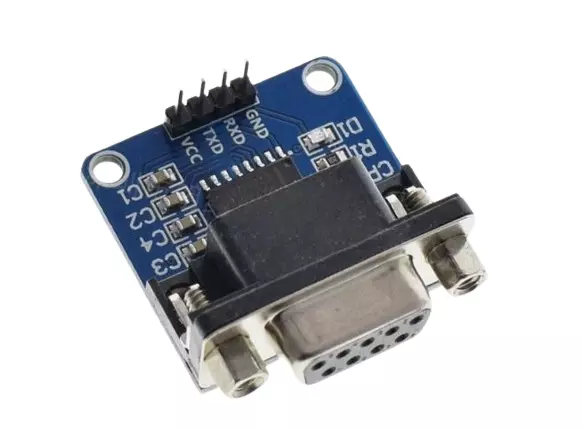


RS232 to TTL Serial Interface Module
An RS232 to TTL Serial Interface Module is a hardware device that facilitates communication between devices using RS232 voltage levels and devices using TTL voltage levels. It acts as a bridge, allowing devices with different voltage requirements to exchange data using serial communication protocols.
Non-returnable
SKU - R-0554
Rs.60.00
Share:
Product Details
Key Features and Functionality:
Voltage Level Conversion: The module converts serial communication signals from RS232 voltage levels (-15V to +15V) to TTL voltage levels (usually 3.3V or 5V) and vice versa.
Bidirectional Communication: The module supports both transmitting (TX) and receiving (RX) data between RS232 and TTL devices.
Signal Conditioning: It includes circuitry to condition and convert the voltage levels of the serial signals, ensuring proper communication between devices with different voltage requirements.
Driver Compatibility: The module allows devices using RS232 voltage levels (common in older computer peripherals) to interface with devices using TTL-level UART (common in microcontrollers, sensors, and embedded systems).
Applications:
Microcontroller Integration: Use the module to enable microcontrollers and other TTL-level devices to communicate with RS232-based equipment, such as modems, industrial machinery, and legacy systems.
Sensor Integration: It facilitates the integration of sensors and other TTL-level devices into systems that use RS232 communication protocols.
Serial Debugging: Engineers and developers use the module to interface with RS232-based systems for debugging, testing, and data monitoring.
Legacy Device Interfacing: The module enables the connection of modern microcontroller-based devices to older RS232-based equipment that might be part of an existing setup.
Usage Considerations:
Voltage Levels: Ensure that the TTL voltage level used by your microcontroller or device matches the TTL voltage levels provided by the module.
Data Rate: Check the supported data rates of both the RS232 and TTL sides to ensure compatibility for your specific communication needs.
Polarity and Wiring: Ensure that the TX and RX connections are properly connected to the respective pins of the devices for correct communication.